
Case Studies
Problem, build, outcome.
Four builds, told the long way. The brain demos show the machinery. These tell the stories: what was broken, what got built, and what changed. Every number here traces to a source I can defend in a room, and where there is no legal number the outcome says so in words instead.
This page is the depth. Four engagements at full length, plus the four growth stories that explain where the pattern recognition came from. Read it if you want to know how I work.
Projects is the breadth. Every project of the career, one line apiece, grouped by era. Read that if you want the range and the dates rather than four long reads. It is the index. This is the argument.
AI Systems
Four builds, in full.
Company brain · 100+ daily users The manufacturer that became an AI company quietly From one overloaded marketer to a system 100+ people open every day.
The problem. A 16-lab dental manufacturer with multiple brands, a growing partner portfolio, and one marketer: me, supporting 50+ internal requesters. Every deliverable was a bottleneck, and every bottleneck was a person waiting on marketing.
The build. The first company brain, designed and built solo from June 2025: the company’s facts, voice, rules and guardrails structured so an AI could be trusted with real work, plus the onboarding to make people actually use it. Reference-first skills for every deliverable type, a routing table, an approval chain, and a rollout treated as a deliverable in its own right.
The outcome. Used daily by more than 100 people. Over 1,000 pieces of collateral produced. More than 20 people personally onboarded and trained, and the AI function that grew out of it is now the division I lead, with a weekly company-wide standup. What that leaves a company is not a tool with one owner. It is a function it can staff.
Client build · Pro bono The firm that fired a retainer it was doing the work for A three-person team now performing like fifteen, saving $1,000+ a month.
The problem. A one-person Florida reserve-study firm paying an agency $1,000 a month for blog posts, page creation and analytics, while writing the content, supplying the images and reading the analytics himself. He diagnosed it while answering one question.
The build. A complete system in one pass: brand OS with measured contrast, a generated website with QA inside the Cloudflare deploy, a company brain with twelve skills, an intake designed so a non-technical owner could succeed at it, and a handoff meeting that ended with his own accounts configured and tested live.
The outcome. A three-person team now performs the function of a fifteen-person team, saving $1,000+ per month. The engagement is pro bono and the saving is his, which the site says plainly rather than letting a dollar figure imply otherwise. The transferable part is the question that found it: which line item is paying for work somebody inside the building already does?
Co-founded product Four founders, three identities in two days, one product Four founders, one machine referee, and a build script that argues back.
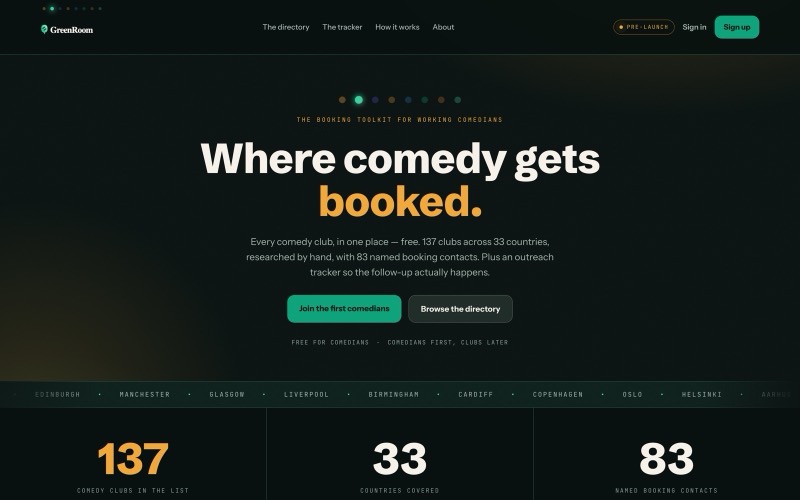
The problem. A comedian with an idea and no way to build it, plus three friends. Comedians do not lose bookings because they cannot find venues. They lose them because follow-ups die in notes apps. Four founders also generate confidently wrong work in four directions at once.
The build. GreenRoom: a 137-venue directory across 33 countries, a free outreach CRM, a dependency-free world map, passwordless auth, and the brand that stuck after three complete identities in 48 hours, every superseded version archived. The build script grew assertions because four founders need a machine referee: chrome byte-identical, links resolved on disk, brand seeds wired.
The outcome. Pre-launch and live, with the venue contacts guarded by a rule the whole team can see: the rows are the product, and they never leave the tool. A rule people can point at is what makes a shared tool safe to put the real contacts into.
Founded · 22 tools The suite specified before a line of code existed Twenty-two tools, written as a spec first and verified by diff, not by vibes.
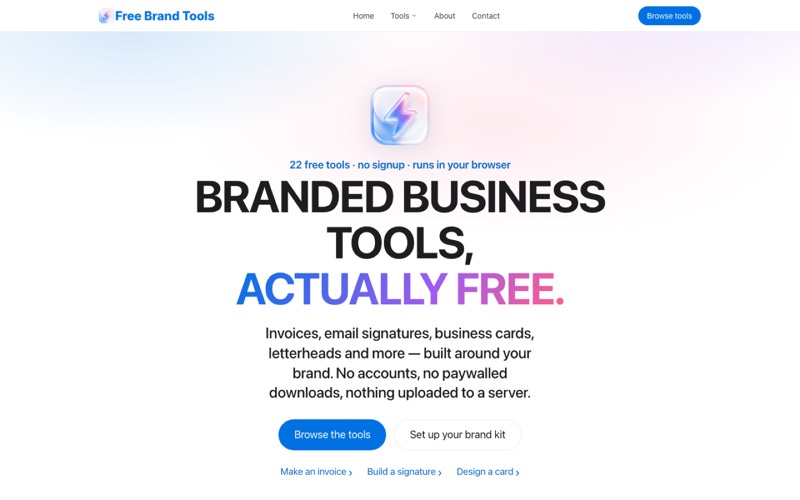
The problem. Branded business documents are the most repeated, least loved deliverable in small-business life, and every generator online wants a signup, a watermark, or your data.
The build. FreeBrandTools: twenty-two client-side tools specified completely before any code existed: storage schema, a five-method API surface, a CSS custom-property contract, a library-selection table. Then delegated, and verified by diffing every produced file against the spec rather than reading the code and feeling good about it.
The outcome. Live, free, and doubled as a component library: the suite ports into every company brain pre-seeded with that client’s tokens, so day one of an engagement ships with twenty-two working branded tools. People are using something in their own brand before the custom build lands, which is when a rollout usually stalls.
The Growth Years
Where the pattern recognition came from.
Before the AI systems, the revenue years: 2020 to 2025, across enterprise B2B, healthcare fundraising and hospitality. Four stories from that era explain most of how I build now. The rest of that period is listed a line at a time on Projects.
Hospitality · LOVE Restaurant Group The Viral Vector Model the system, not the campaign.
Running a $32M multi-market portfolio, I co-authored a growth framework that applied epidemiological principles to campaign design: marketing adoption modeled like viral transmission, each campaign engineered for a reproduction rate above 1.3 so it spread person to person, carried by customers rather than pushed at them. The machinery underneath was hyper-specific audience segmentation, spend concentrated where spread was likeliest, grassroots reps on the ground, and AI-driven analytics with dynamic pricing. It was the first time I used AI tools to design the strategy itself rather than just the assets.
During the program, catering sales rose 61%, marketing expenses fell 20%, and overall revenue rose 14%. Across the era, the portfolio grew 15% year over year with a B2B catering engine adding $3.5M on top. The framework itself became a co-authored whitepaper. An excerpt will appear here once a scrubbed version is ready.
What survived into everything since: model the system, not the campaign.
Hospitality · LOVE Restaurant Group The AI Pricing Engine Applied AI inside a real profit-and-loss decision, before the brains existed.
A human-in-the-loop AI pricing engine for menu decisions. The AI analyzed historical sales before and after every price change, demand elasticity, competitor pricing, and consumer-psychology research, and recommended prices from all four. The humans curated what went in and validated every recommendation through iterative passes, and the outputs drove real menu decisions. I claim no outcome metric for it, because none is defensible yet, and this site does not publish numbers it cannot defend.
What it marks is the start of the arc: applied AI inside a real profit-and-loss decision, before the company brains existed. Chapter one of the same discipline.
Hospitality · LOVE Restaurant Group The systems before the AI The adoption discipline existed here first, on spreadsheets and CRMs.
Two builds from the same years, neither of them glamorous. First, a self-built automated sales dashboard across ten locations and a food truck: weekly reporting, year-over-year adjusted comps, multi-year history, predictive labor models, and stakeholder emails that sent themselves. Second, a full CRM implementation on HubSpot: data migration, ZoomInfo and EZ Cater integrations, pipelines, automation workflows, SOPs, and 20+ people personally trained, serving an organization of 1,500+ employees against operating targets like $11,600 in weekly catering sales per market.
The adoption discipline that later became the Company OS method existed here first: training, SOPs, and governance, run on spreadsheets and CRMs.
Manufacturing · Rebrand Unifying a lab network A brand in a PDF is a suggestion. A brand in a system is a fact.
Leixir Dental Group had grown by acquisition into a family of disconnected brands. On a contract engagement I led rebrand work that unified the group’s identity and overhauled the corporate site that carried it, an early rehearsal for the 16-lab rebrand I would later direct. The lesson that stuck: a brand that lives in a PDF is a suggestion, and a brand that lives in a system is a fact. This rebrand is where the lesson that became Brand OS, the brand layer of the Company OS, was first learned. It is the reason every engagement now starts with a Brand OS.
Provenance
Where the numbers come from.
Every quantitative claim on this site traces to one records file, and the rule that file enforces is simple: never invent, never round past what it holds, and where a number is unknown, say UNKNOWN rather than guess. What that means for each family of figures:
The deployed system’s own usage record. The daily-user count is measured on a daily basis, not weekly or monthly. Collateral is cumulative. Training is hands-on, person by person. Confirmed August 2026.
A named client, published with the client’s permission. The dollar figure is their own monthly saving after replacing their agency. Confirmed August 2026.
Measured from the systems themselves: file counts, repository sizes, and deployment dates, not estimates.
From budgets owned and results reported in each prior role. Kept only where defensible. Anything unverifiable stays off the site.
The Breadth
That is four of them, in detail.
Everything else I have built, from the growth years through the AI systems, is cataloged one line at a time and grouped by era. Go there if you want the range and the dates rather than the detail, and come back here for whichever entry you want to see argued.