
The Company OS
Guardrails.
The Gates. How the Company OS is kept honest.
Every system I ship draws one line: a rule written in a document is a preference, and a rule wired into the pipeline is a guardrail. The Company OS calls that layer the Gates, and the difference is what happens on a bad Friday afternoon.
Rules become code
A reminder depends on a person remembering it. A gate does not get tired, does not skim, and does not decide the deadline justifies an exception. So the house style is a regular expression with a non-zero exit behind it. The confidential terms are a scrub list the build refuses to ship. The draft quotes on this very site cannot launch, mechanically, while any remain.
That is what the name means. Guardrails are the rules, and the word stays: everything below is written as one. The Gates are what the rules become once the build enforces them, because a gate does not remind anyone of anything. It refuses to open.
Frame rules as refusals
Every brain’s guardrails read as things the system will not do: never invent a price, never name a person’s contact details, never answer outside this engagement. Refusals beat aspirations for one reason: a refusal is testable. You can hand the system a request it must decline and watch what happens. The acceptance test for every install includes questions where the correct answer is a refusal, because proving a system declines is harder and more useful than proving it produces.
Watch the system say no
Four requests a company brain actually receives. Two get built. Two get refused, with the rule that fired named to the requester’s face. Every response below is prewritten and static: no API, nothing generated while you watch, because the point is the design of the answers rather than a magic trick.
Done. Built from the gold-standard one-pager with this account’s facts swapped in. Pricing pulled from the approved price sheet, dated this quarter. Two facts I could not source are marked UNKNOWN and filed as questions 41 and 42 rather than guessed. Draft is in the review queue for approval.
Why this answer: The request routes cleanly: a known deliverable, an approved reference, facts with sources. This is the loop working when everything is in order.
I cannot add that. No approved source contains a comparative turnaround claim, and guardrail 4 forbids publishing performance numbers that do not trace to an authority file. If the claim is real, add its source to the facts layer with sign-off and I will use it everywhere it fits. Until then the line reads as an unverifiable promise a competitor can challenge.
Why this answer: The refusal cites the rule and the escape hatch. A system that refuses without a path forward trains people to route around it. This one turns the refusal into a to-do.
I will not export that. The directory’s contact rows are governed by a hard rule: they never leave the tool, in any format, for any campaign. They are hand-researched people who did not consent to bulk outreach, and one blast converts the product’s core asset into spam. I can build the outreach workflow inside the tracker instead, where sends are individual, logged and rate-limited.
Why this answer: The hardest refusals protect people who are not in the room. The rule exists precisely because the request is reasonable-sounding and the harm is diffuse.
Here is the card rebuilt with the brand’s highest-contrast accent treatment, which is the loudest the system goes. Straight red is not in the token sheet, and the build would reject it as an off-brand hex anyway, so instead of arguing taste I have produced the approved-loud version plus one alternative using the accent-on-dark pattern. If the brand needs a red, that is a token-sheet decision with an owner, not a per-card override.
Why this answer: Not every guardrail moment is a flat no. This one redirects: the request’s intent is served, the brand system survives, and the escalation path is named.
Every install ships with an acceptance test where some of the correct answers are refusals. Proving a system declines cleanly, citing its rule, offering the escape hatch, is harder and more valuable than proving it produces output, because the refusals are where trust is actually built.
Watch two sources disagree
Refusing a bad request is half the honesty layer. The other half fires when two of the company’s own files answer the same question differently. Every brain carries a trust order for exactly that moment: Approved beats Facts beats Work Zone, and everything outside the order is UNKNOWN. Pick a question below and watch it resolve.
A working model of the real mechanism, on fictional documents: the trust order and the refusal to guess are exactly what production systems do, and the company is invented. Nothing you do here is transmitted.
SOURCE A · APPROVED · price sheet
approved/pricing/2026-q3-price-sheet.md
Meridian starter kit: $1,480 per unit, effective July 1. This sheet is the only file a price may be quoted from.
SOURCE B · DRAFT · proposal
work-zone/proposals/northlight-bundle-draft.md
Suggest we float the Meridian starter kit at $1,295 inside the bundle as an opener. Needs review.
RESOLVED: the Meridian starter kit is $1,480 per unit, citing the approved price sheet. Approved beats Draft. The proposal’s $1,295 is a pitch, not a price, until a human promotes it.
The trust order, highest authority first
- 1 · APPROVED
- 2 · FACTS
- 3 · WORK ZONE
- everything else · UNKNOWN, filed as a question
Watch your controls fail
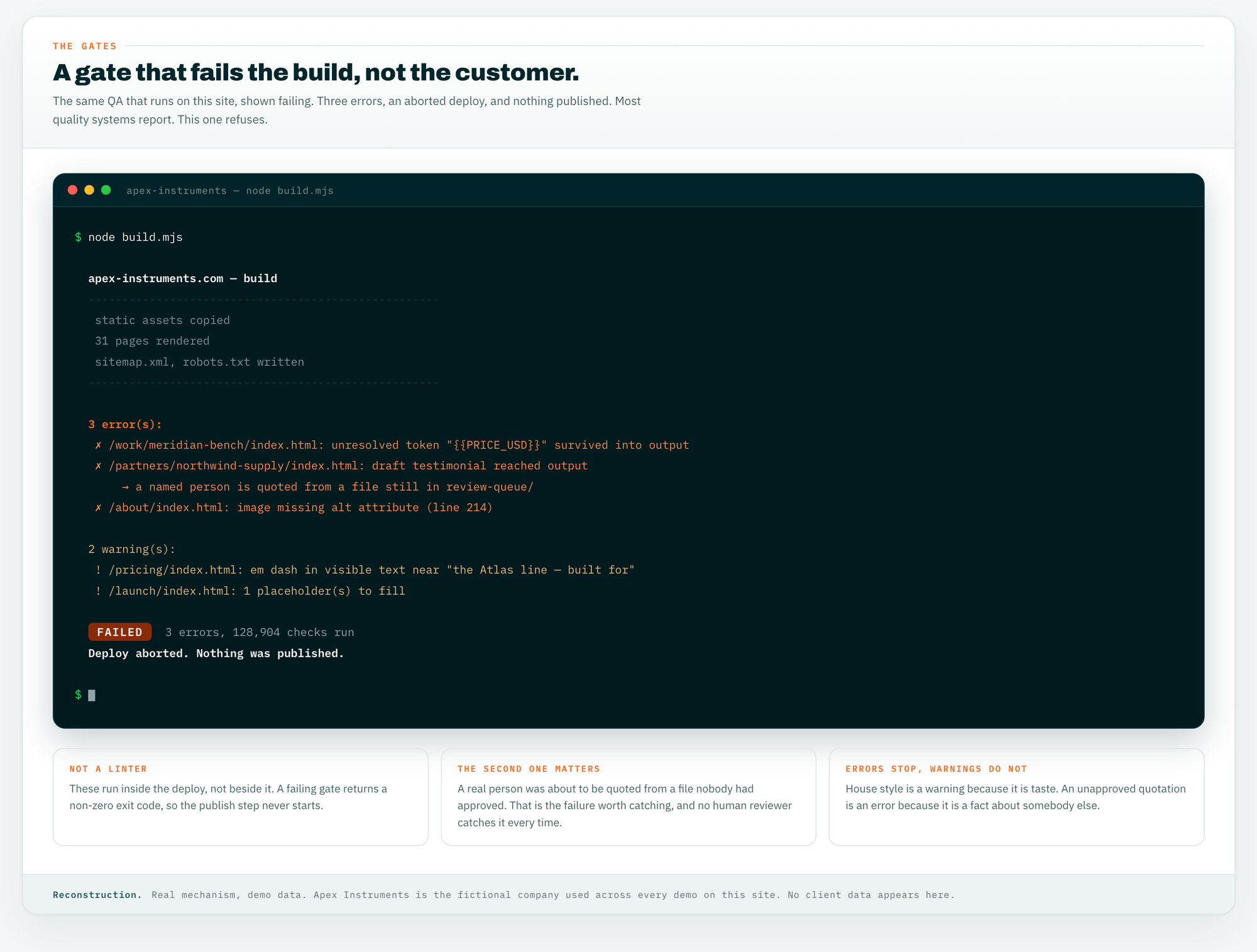
The best guardrail story I can tell is against myself, and it is already public on this site. The scrub gate protecting confidential terms here was wrong twice: it scanned only HTML while a forbidden term shipped inside a CSS comment, and it stripped script blocks before checking, which exempted the riskiest content on the site. Both times it reported clean. A control that reports clean while broken is worse than no control, because it manufactures confidence.
Both faults were found by an independent audit, fixed by widening the scope until there was nowhere left to hide, and then verified the only honest way: planting a violation and watching the build die. A control nobody has watched fail is a belief.
Why bother
Adoption is a trust problem. People stop using a system the first time it confidently does something wrong, and they do not come back. Guardrails are not there to constrain the AI. They exist so a human can send the output without re-checking everything, which is the entire value of having the system.
The real gate, including the account of both failures, is quoted verbatim on how this site is built.
A control nobody has watched fail is a belief.
The scrub gate guarding this site’s own build was wrong twice, and it reported clean both times. An independent audit found the faults, the scope was widened until there was nowhere left to hide, and the fix was proven the only honest way: a violation was planted and the build died.