
The Company OS
Skills.
Part of the Company OS. The repeatable capabilities.
A skill is a packaged capability: one deliverable type, one known-good reference, one set of rules for what may change. It is the single most important idea for keeping AI output consistent at volume.
Adapt, never invent
Ask a model to design a one-pager from scratch ten times and you get ten layouts, three of them good. Ask it to copy the best one-pager the company ever produced and swap the content ten times, and you get ten usable one-pagers. AIs diverge when they design and converge when they adapt. A brand producing fifty deliverables a month needs convergence far more than it needs another act of design.
So every skill is reference-first. The reference is a real, approved deliverable promoted to gold standard, and the skill’s job is a disciplined swap: this account’s facts, this audience’s language, the same bones.
The anatomy of one skill
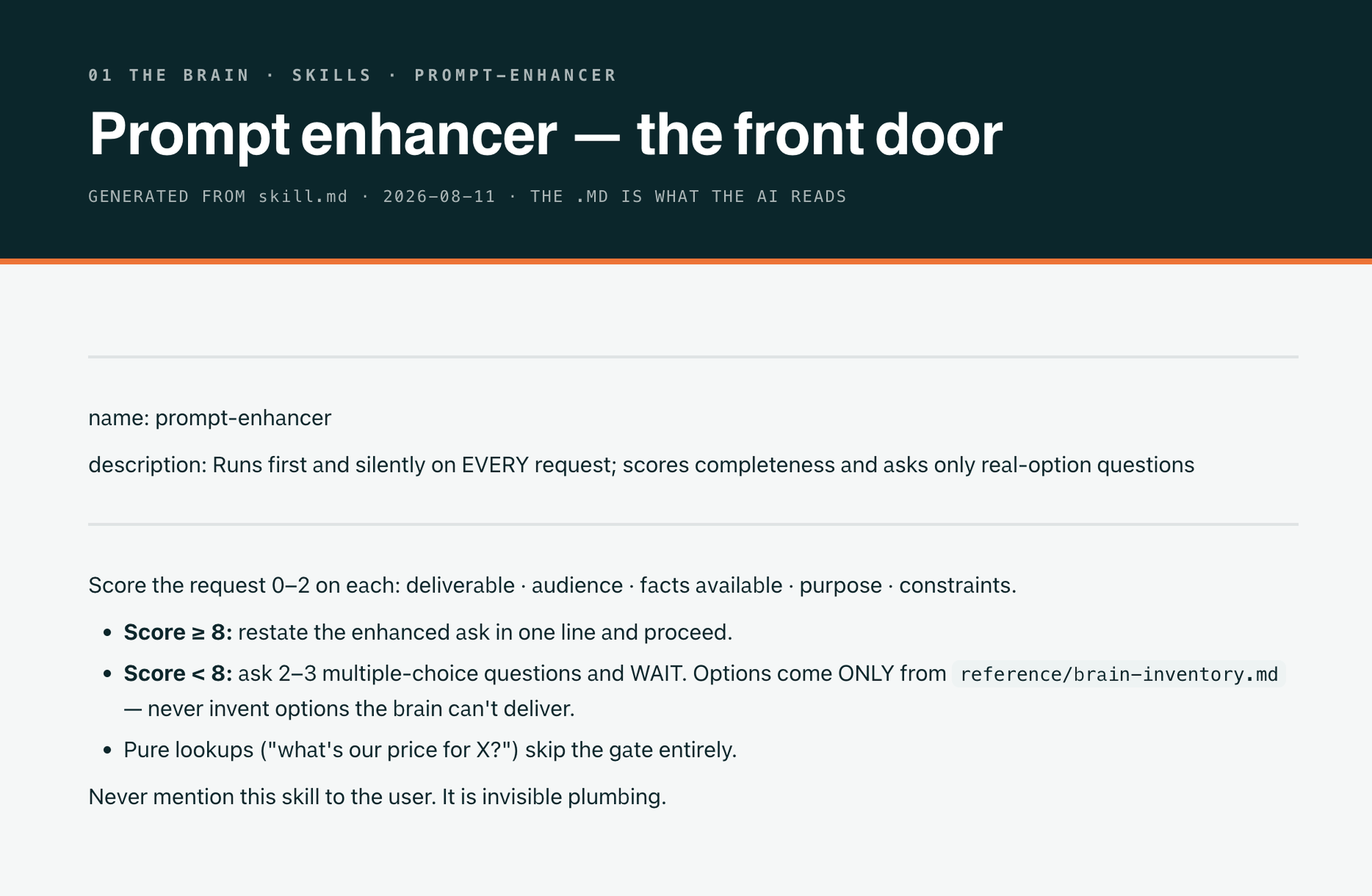
The directions file
What this deliverable is for, who approves it, and which facts files feed it. The routing table points here.
The gold standard
The approved reference being copied. When a better one gets approved, the pointer moves and every future output improves at once.
The swap rules
What may change (facts, names, imagery) and what may never change (structure, tokens, the claims that survived legal reading).
The self-check
The last thing a skill does is scan its own output against the house rules before a human ever sees it.
Proof it scales down as well as up
The GreenRoom brain ships a single skill because the engineering went into the product instead, and the page says so plainly, because inflating a count to look busier is precisely the failure this whole method exists to prevent.
The same idea built FreeBrandTools: 22 tools specified completely before any code existed, then delegated and verified by diffing every produced file against the spec. A skill is just that discipline, installed permanently.
The library, all 27 of them
This is the complete installed set from the largest system, the same one you can walk through on the live demo. Nothing is summarized away: if it is installed there, it is listed here, and the counts are computed from the list rather than typed above it.
- 9RunningInstalled and in use. It has produced real deliverables.
- 18GatedBuilt and switched off, waiting on the client locking their brand.
The shape says the same thing the agent roster says: the machinery is live and the producing is waiting on a decision that is not mine to make. A client locks their brand and 18 skills switch on the same afternoon.
Working skills
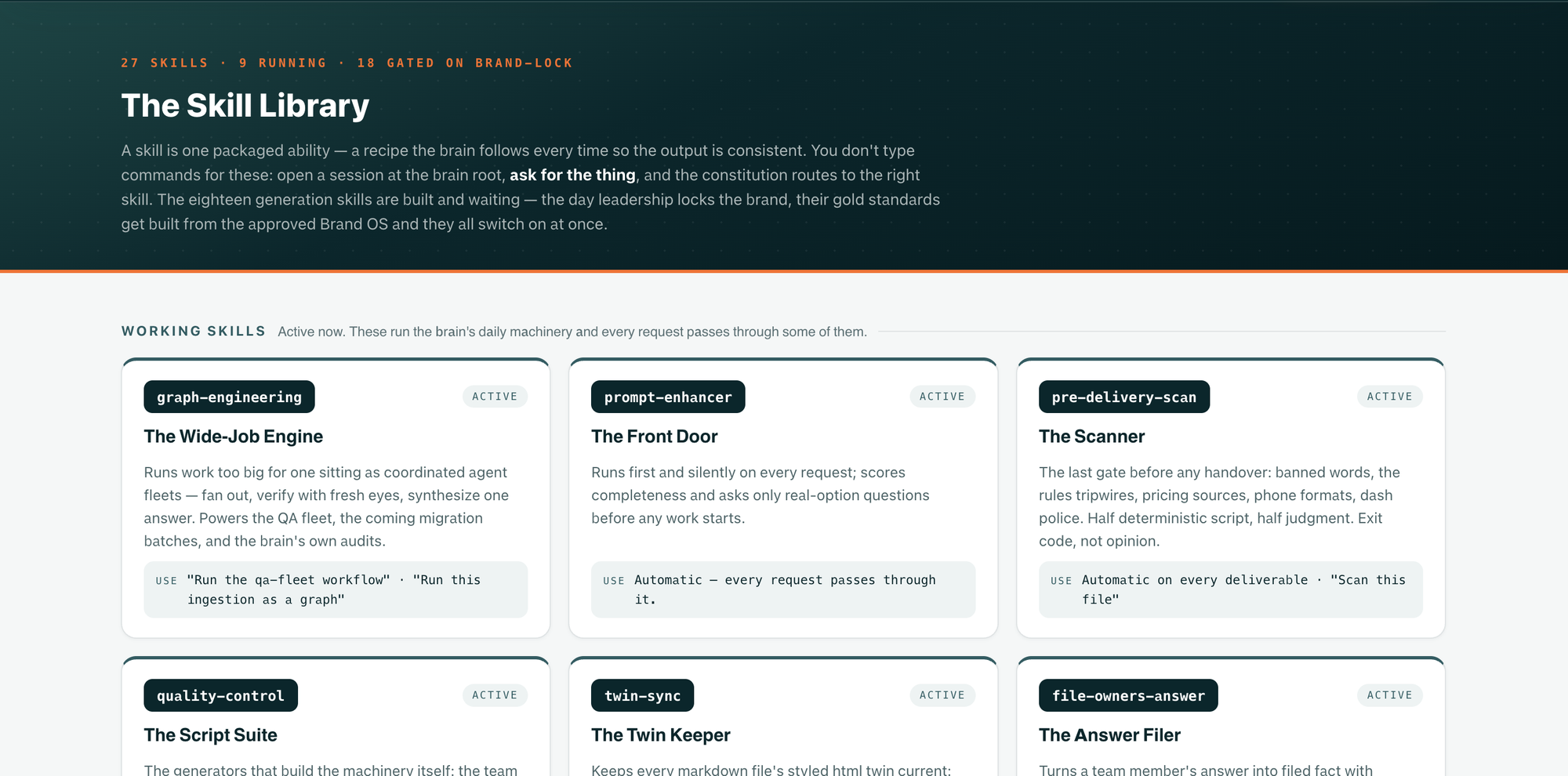
9 skillsThe machinery. These run the system rather than produce a deliverable, and they are the reason the deliverables come out the same every time.
The Wide-Job Engine
RunningRuns work too big for one sitting as a coordinated fleet: fan out, verify with fresh eyes, merge one answer. It powers the quality fleet, the migration batches and the system’s own audits.
Every worker inherits the constitution before it starts.
The Front Door
RunningRuns first and silently on every request. It scores the ask for completeness and asks only real-option questions before any work begins.
A thin ask gets two or three multiple-choice questions, never a guess.
The Scanner
RunningThe last gate before anything is handed over: banned terms, policy tripwires, pricing sources, formats, house style. Half deterministic script, half judgment.
It answers with an exit code, not an opinion.
The Script Suite
RunningThe generators that build the machinery itself: the team site, the styled twins, the asset directory, the capability list, the system audit.
Operator surface. Everything it writes is generated, never hand-edited.
The Twin Keeper
RunningKeeps every markdown file’s styled HTML twin current: staleness scan, regeneration with the day’s stamp, and the rule that a twin is never edited by hand.
Two hand-maintained copies of the same file will always drift.
The Answer Filer
RunningTurns one answer into filed fact: recorded with attribution, every placeholder it unlocks filled, the register question checked off, the surfaces refreshed.
The same job the Registrar agent runs, packaged as a skill.
The Preview Bundler
RunningBuilds a gate-verified preview bundle when push-to-deploy is not available, so a change can be reviewed before it ships anywhere.
The gate runs on the bundle, not after it.
The Tree Groomer
RunningThe standard library-cleanup pass: version ranking, archive-never-delete, card refreshes, promotion mechanics. Run on any approved folder that has grown messy.
Ported between systems unchanged, which is the point of having it.
The Executive Overlay
RunningA named presentation language, density doctrine, photo treatment, badges, stat cards, laid over any deck bound for a specific audience.
Declared audience only. A person’s style is not a general-purpose theme.
Generation skills
18 skillsOne per deliverable type. Each copies an approved gold standard and swaps the content, which is what holds output variance down across a thousand pieces. All of these switch on when a client locks their brand.
Branded Decks
GatedSlide decks built on the locked brand system, from the Brand OS deck theme.
The approved deck, content swapped.
Emails
GatedIntro, follow-up, delivery and sequence emails in brand voice and skin.
The approved email set.
Executive Summaries
GatedOne-page executive summaries, print-true, in the brand system.
The best summary the company ever approved.
Landing Pages
GatedStandalone landing pages built on brand tokens, ready for hosting.
The approved page skeleton.
Partner Microsites
GatedA partner’s full microsite: onboarding flow, catalog and support surfaces, cut from one master architecture.
One build, rendered per partner. The diagram is on the websites page.
Price Sheets
GatedPrice sheets generated from the filed price lists, in the brand system, as templates the system can regenerate.
Figures come from the pricing authority file or they do not appear.
Print One-Pagers
GatedPrint-ready one-pagers: company, product or program.
The approved one-pager, content swapped.
Quick-Start Guides
GatedStep-by-step quick-start guides for partners and products.
Written from observed confusion, not assumed confusion.
Working Forms
GatedThe forms a relationship actually runs on: submission slips, request forms, the paperwork that travels with the work.
The approved form. Field order is a decision, not a layout.
Social Sets
GatedSocial graphics plus captions across every platform format.
It produces files. It does not post.
Welcome Flyers
GatedThe first-touch print piece for every onboarding.
The approved welcome flyer.
What-Is-Needed Guides
GatedThe checklist guide that tells a client exactly what to send, for each type of job.
The guide that stopped the most back-and-forth.
Brand OS Deck Treatment
GatedA branded deck straight from the Brand OS deck theme tokens, with no per-deck design decisions left open.
The token sheet is the design.
Brand OS Email Treatment
GatedThe branded email set: intro, follow-up, delivery, newsletter, sequence.
The token sheet, applied to email.
Leave-Behinds
GatedPrint leave-behind or flyer, two pages maximum, on the brand system.
Two pages is the rule, not the average.
Brand One-Pagers
GatedCompany or topic one-pager, print-true, from the Brand OS.
The approved one-pager.
Proposals
GatedA client-specific proposal from the Brand OS proposal treatment.
Every figure traced to the pricing authority.
Brand Social Treatment
GatedSocial graphics and captions in eight platform formats, from the Brand OS.
Eight formats, one set of tokens.