
The Company OS
The operating loop.
Part of the Company OS. The cadence: how the OS runs and improves.
This is the cadence of the Company OS: how it runs, and how it improves. Every request runs the same seven-step line, and everything the line approves feeds back into the system. The steps are not ceremony. Each one exists because skipping it produced a specific, remembered failure.
The most damaging phrase in company AI is it’s just a quick one.
Quick pieces skip intake, skip the facts, skip the scan, and become the off-brand document a partner receives. So the loop is the loop, for everything.
The seven steps, with a request walking through them
Take the most ordinary ask a system gets: make a one-pager for a new account.
1 · Ask
Anyone in the circle asks, in plain language. The system meets people where they type, or adoption dies at the door.
2 · Enhance
A prompt-enhancer silently scores the ask first. Make a one-pager
is thin: which account, which audience, which of the approved offers? Thin asks get two or three sharp multiple-choice questions. The alternative is a confidently wrong draft, and every confidently wrong draft spends trust the system cannot buy back.
3 · Route
The constitution’s routing table maps this request type to the exact files it needs: the one-pager directions, the matching skill, that account’s facts. It never crawls the whole tree. Same start every time is why quality is the same every time.
4 · Ground
Pricing comes from one authority file. Claims come from another. When sources disagree, an explicit trust order settles it: approved beats facts beats drafts. Anything not found is UNKNOWN, filed as a numbered question, never guessed.
5 · Build
The skill copies the gold-standard one-pager and swaps the content. AIs diverge when they design from scratch and converge when they adapt, and a brand at volume needs convergence.
6 · Scan
The pre-delivery scanner checks the draft: banned terms, confidentiality tripwires, house style, raw hex outside the token sheet. It answers with an exit code. A failure stops the line rather than shipping with a note attached.
7 · Approve
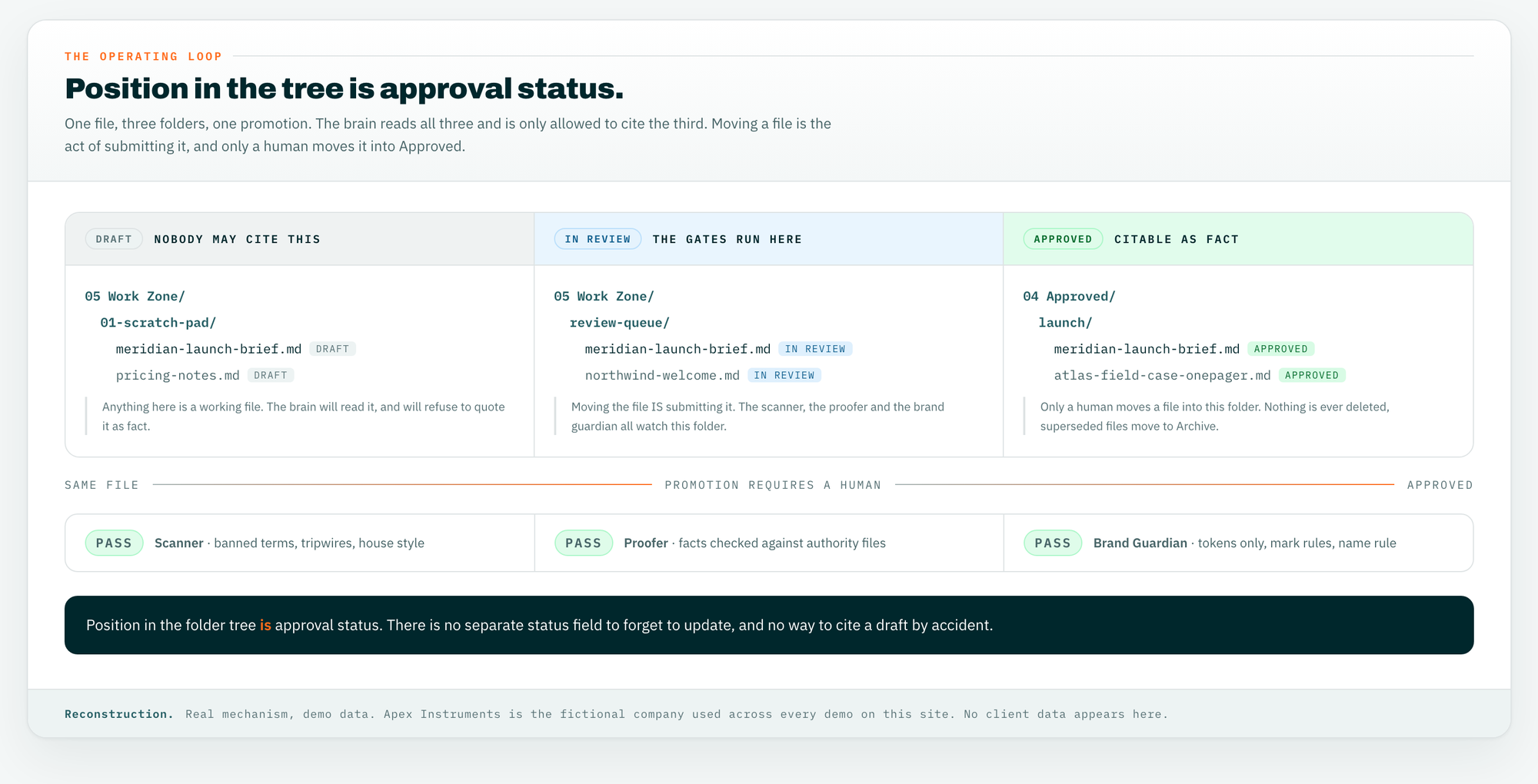
The draft lands in a review queue. A named human promotes it to the approved library, and only from there does anything reach the outside world. Position in the folder tree is approval status, so nothing ships by accident. Superseded work is archived, never deleted.
The learning loop
Approval is not the end of the line. Every piece a named human promotes becomes part of the system itself: the deliverable joins the approved library, where a skill can adopt it as its next gold standard. The decision behind it lands in the decisions log with an owner and a date. The questions it answered close in the register, and the changelog records why. Nothing that was learned stays in one person’s head or one chat’s history.
That is step eleven of the method, and it is why the system is worth more in month twelve than in month one. The month-one build knows what the intake collected. The month-twelve build also knows every approval, every refusal that held, and every decision the company settled along the way, and it answers from that record. Most software depreciates as the company changes around it. A Company OS runs the other direction, because using it is what feeds it.
The Homeowner Insights brain shows the routing table, the enhancer and the deploy gate, including a verbatim excerpt of the real scanner under its Source tab.