
The Company OS
The intake form.
The intake that feeds the brand layer of the Company OS.
Every brain build starts with the same questions, because the quality of a system is decided by what goes into it. Sixty fields, eleven sections, and the part worth noticing: every answer is mapped to the exact file it produces in the finished brain. Nothing is collected without a destination.
Fields marked ★ are required. Anything left unanswered does not block the build: it ships as a numbered open question in the new brain’s register, and the system says UNKNOWN rather than guessing until the answer arrives. The form can be completed incrementally.
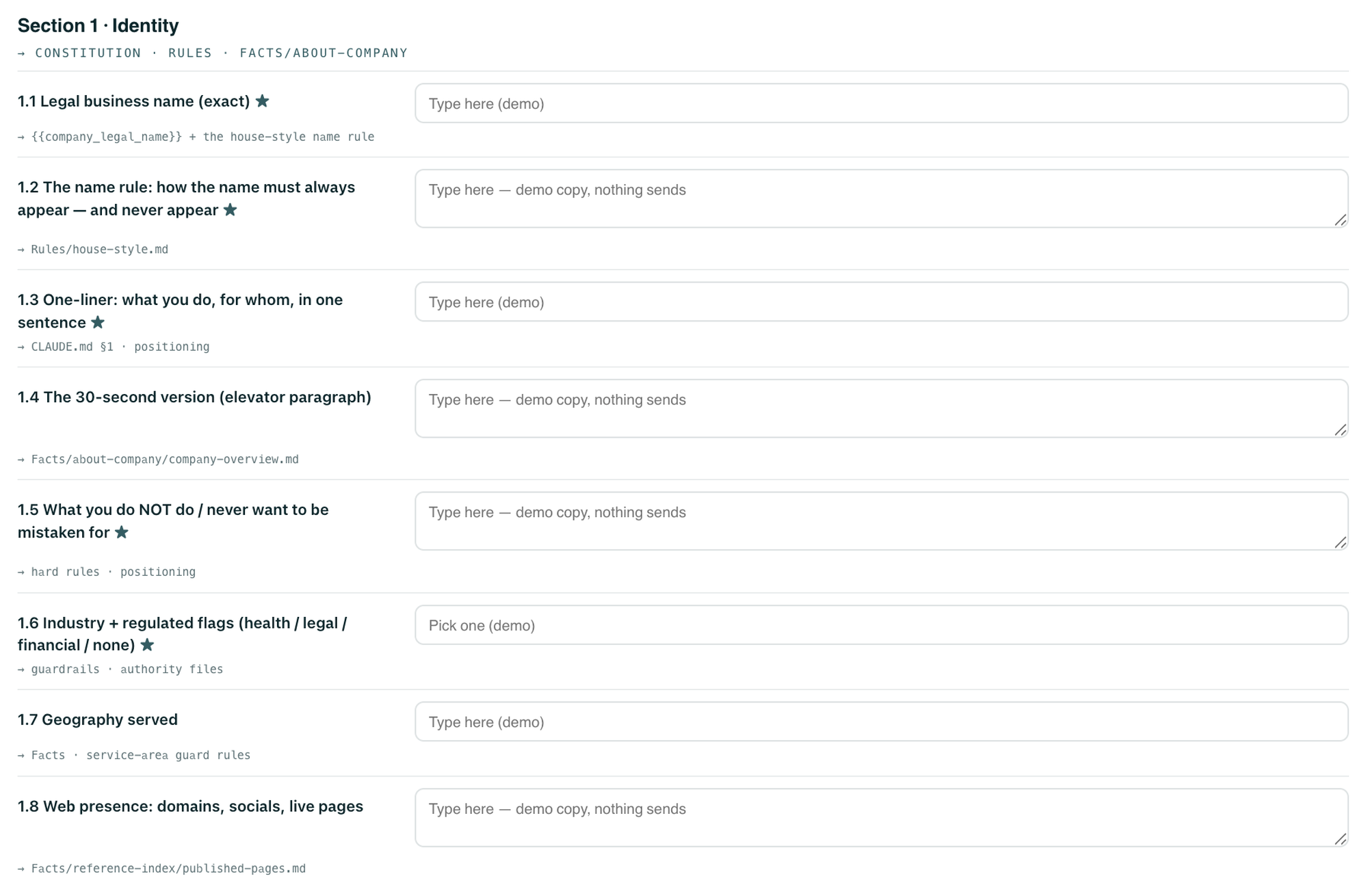
Section 1 · Identity
feeds → the constitution, house rules, company facts
- ★Legal business name, exactly as it must appear
- ★The name rule: how the name always appears, and how it must never appear. Abbreviations, the comma before LLC, permitted short forms
- ★The one-liner: what you do, for whom, in one sentence
- The thirty-second version, an elevator paragraph
- ★What you do NOT do, and what you never want to be mistaken for
- ★Industry, plus regulated flags: health, legal, financial, insurance
- Geography served, which becomes a hard rule if the answer is one state
- Web presence: domains, socials, existing live pages
Section 2 · People
feeds → governance and the org facts
- ★Owner and final approver: name, role, contact
- ★The brain operator, whoever runs the AI day to day
- Additional approvers, and what each may approve
- Team roster: name, role, contact, headshot
- ★The money, legal and external-send gate: who can never be bypassed
Section 3 · Audiences
feeds → the target-audience files, two to four of them
Answered once per audience:
- ★A label, like
HOA board member
, and who they actually are - What they want, and what they fear
- Words they use, and words that turn them off
- The single action we want from them
- ★Which one is the hero audience. Exactly one yes
Section 4 · Voice
feeds → the voice files
- ★Three to five voice adjectives
- ★The default tone, picked from seven named registers
- Approved signature phrases: things you actually say
- ★Banned words and phrases
- ★Three writing samples you love, yours or anyone’s, for reverse-engineering the voice
- Mechanics: emoji policy, exclamation policy, whether humor is allowed
Section 5 · Hard rules
feeds → the guardrails
- ★
This AI must NEVER…
say, do, or claim - ★Pricing publishing policy: public, quote-only, never published, or gated
- Claims we can prove, each with its source, versus claims we must never make
- Competitor mention policy
- Anything low-profile or confidential the system must protect
- House mechanics: date format, phone format, dash policy, capitalisation
Section 6 · Facts
feeds → the facts layer, the part everything else cites
- ★Services and products: plain-English description, who it is for, price or range, timeline, which one is the flagship
- ★Pricing detail, and exactly what is quotable
- Credentials, licenses, certifications, awards. Verifiable only
- Founding story, history, key dates
- Stats you can cite, each with its source
- ★The top ten questions clients ask, with your best answers
- Testimonials, with written-permission status per quote
- ★The document upload manifest: decks, price lists, sample deliverables, SOPs. Preserved verbatim
Section 7 · Market
feeds → competitor and SEO facts, and module triggers
- Top three to five competitors, with your one-line take on each. Verified by live search at build time
- Service area detail: cities and regions, ranked
- Why you win: two to four pillars
- SEO ambition, and target searches if known
- Where clients actually come from today
Section 8 · Brand
feeds → the Brand OS, and house style
- ★Brand maturity: a full Brand OS exists, or logo and colors only, or starting from scratch
- Upload manifest: logos, fonts, guideline documents, collateral you love
- Known color codes
- Visual direction words, and brands you admire
- The visual never-list
- If starting from less than a full system: the Brand OS build request is generated automatically, and audited against a five-part contract before assembly proceeds
Section 9 · The collateral menu
feeds → skills, templates, and the routing table
- ★Pick from the catalog: print, web, email, presentations, social, business documents, sales and ops
- ★The first three pieces you need on day one. These become the reference gold standards, built first
Section 10 · Modules and infrastructure
feeds → optional modules and integrations
- Website: keep existing, rebuild inside the brain, or none
- A content and SEO engine, yes or no
- Partner or account kits, and the list of accounts
- Team size, which selects the workflow-zone variant
- Meeting and transcript filing
- Accounts that exist: repository, hosting, workspace, CRM, email sender. Credentials are never collected on a form, dashboard-only, as a rule
Section 11 · History
feeds → the memory layer
- Decisions already locked, which the AI must not reopen
- Known unknowns, seeded straight into the questions register
- In-flight work: campaigns, launches, deadlines
An intake packet: every answer keyed to its destination file, every unanswered field as a numbered open question, every promised upload with its target path, and a completion percentage. The packet, the uploads, and the signed-off Brand OS are the complete input to the build. The gap between this form and a finished brain is assembly, not invention.