
The Company OS
The component map.
Part of the Company OS. The architecture, component by component.
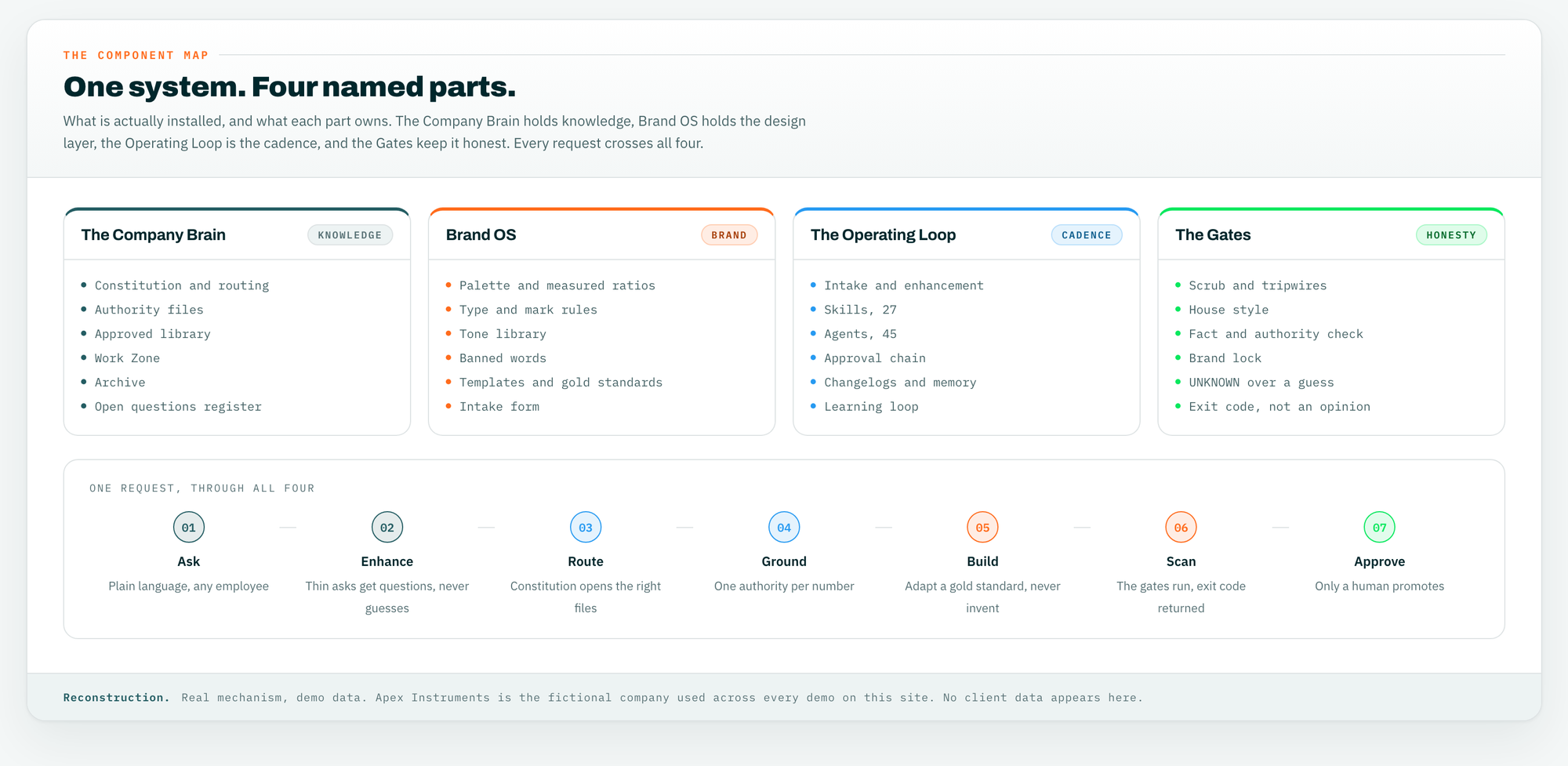
Every brain I ship carries a map of itself: nine layers, what each holds, what each is waiting on. If the team cannot see the whole machine, they will not trust any part of it.
The constitution
The file the AI reads first, every session: identity, load order, the routing table, the trust order, the hard rules, the output checklist, and the approval roster. A generated mirror serves any other AI the team points at the library.
Rules
Guardrails, house style, the voice trio, writing tones, target audiences, and the direction files that script entire builds. How to act, written down.
The fact layer
Company overview, the authority files that are the only legal source for a price or a claim, the decisions log, the team and escalation map, and distilled meetings. What is true, with one home per truth.
Skills
Packaged abilities, each built to copy a gold-standard reference and adapt the content. AIs diverge when designing and converge when adapting, so every skill starts from a reference.
The Brand OS
The identity as a token system with measured contrast and usage law. The design layer everything else obeys, and where every engagement starts.
The send-ready library
Every drafted piece filed with its approval state and the open questions gating it. Slots render visibly, so a half-approved draft can never pass as finished.
The approval lifecycle
Personal work zones with a five-folder flow. Position in the tree is approval status, only a human promotes work, and nothing is ever deleted.
The registers
A mandatory changelog, the questions ledger, the decisions log, and the work log. Memory and accountability, always current, never optional.
The gated layers
Whatever waits on a real-world gate says so: skills gated on brand lock, public surfaces gated on launch. A promise with a named gate is a plan. Without one it is vapor.
The live version of this map, filled in and clickable, is on the demo: walk it there.