
The Company OS
AI that works the way your company works.
Buying an LLM gives a company AI capability. It does not give the company an AI operating system. The Company OS is that missing layer: the knowledge, rules, workflows, brand, quality control, and training that turn a model into how the business actually runs.
The Idea
Most AI experts know how AI works. I know how to make AI work inside an actual company.
Most companies treat AI as an access problem: buy the software, tell the team to go use it. Every employee then invents their own prompts, sources, standards, and methods. A few become power users. Most barely touch it. The company gets experimentation, not transformation.
The problem is not that AI is not capable enough. The problem is that nobody built the system around it. That system is what I design and install: knowledge plus architecture plus governance plus workflows plus integrations plus quality control plus adoption. Not another AI login.
Prove It In Five Minutes
Do not take the argument. Take the tour.
Three stops, all real, all on this site or its live demo. Five minutes tells you whether the rest of this page is worth your time.
Watch a real task
Ask the live demo
A working custom LLM over a real company brain. Ask it for something and watch it cite its files, or refuse to guess.
Look under the hood
Read the architecture
Further down this page: the layers underneath, what feeds what, and why each part exists.
Watch it touch the business
Run the loop
A week of work moving through the system, step by step, with the gates in the way on purpose.
The Named Parts
Four components. One method.
One system with named, working parts: the Company Brain, Brand OS, the Operating Loop, and the Gates, installed by one method written out step by step. Each card opens the page that documents it.
Component 01
The Company Brain
The knowledge core. Company facts, prior work, and decisions structured so AI can use them: one source per truth, a routing table, a trust hierarchy, and UNKNOWN where the record is silent. Running in production at 4 companies.
Walk the brains →Component 02
Brand OS
The brand layer. The whole identity written down as a system an AI can obey, with the gate that enforces it mechanically. It is why the output is on brand on the thousandth piece, not just the first.
Browse the brand systems →Component 03
The Operating Loop
The cadence. Every request runs the same line: intake, routing, grounding, build, scan, approval. Approved work feeds back in, so the system is worth more in month twelve than in month one.
See the loop →Component 04
The Gates
The honesty layer. Facts, numbers, brand, and claims checked mechanically before anything ships. A violation fails the deploy instead of reaching a customer, and a gap says UNKNOWN instead of guessing.
See the Gates →Under the Hood
For the person who checks.
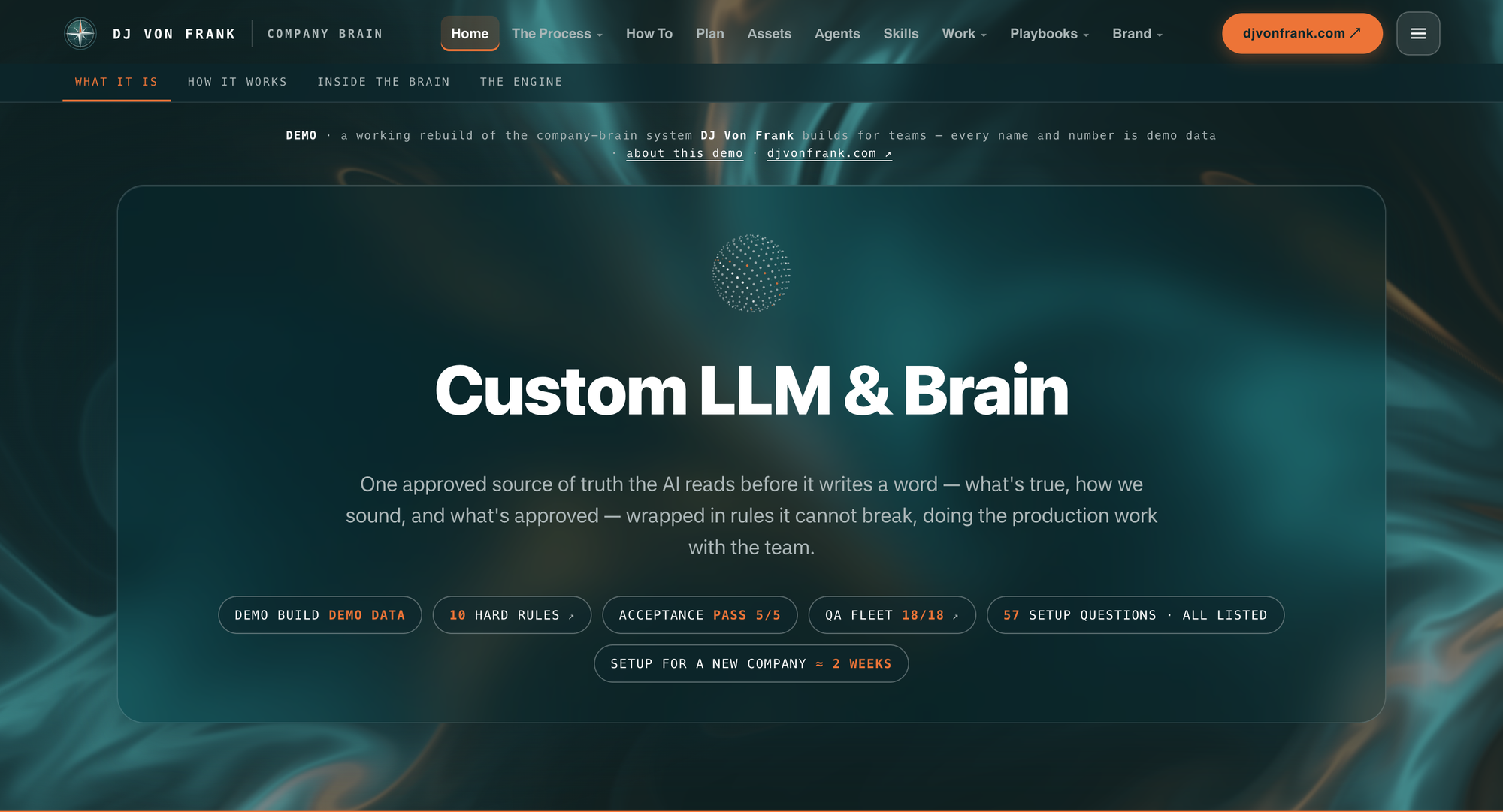
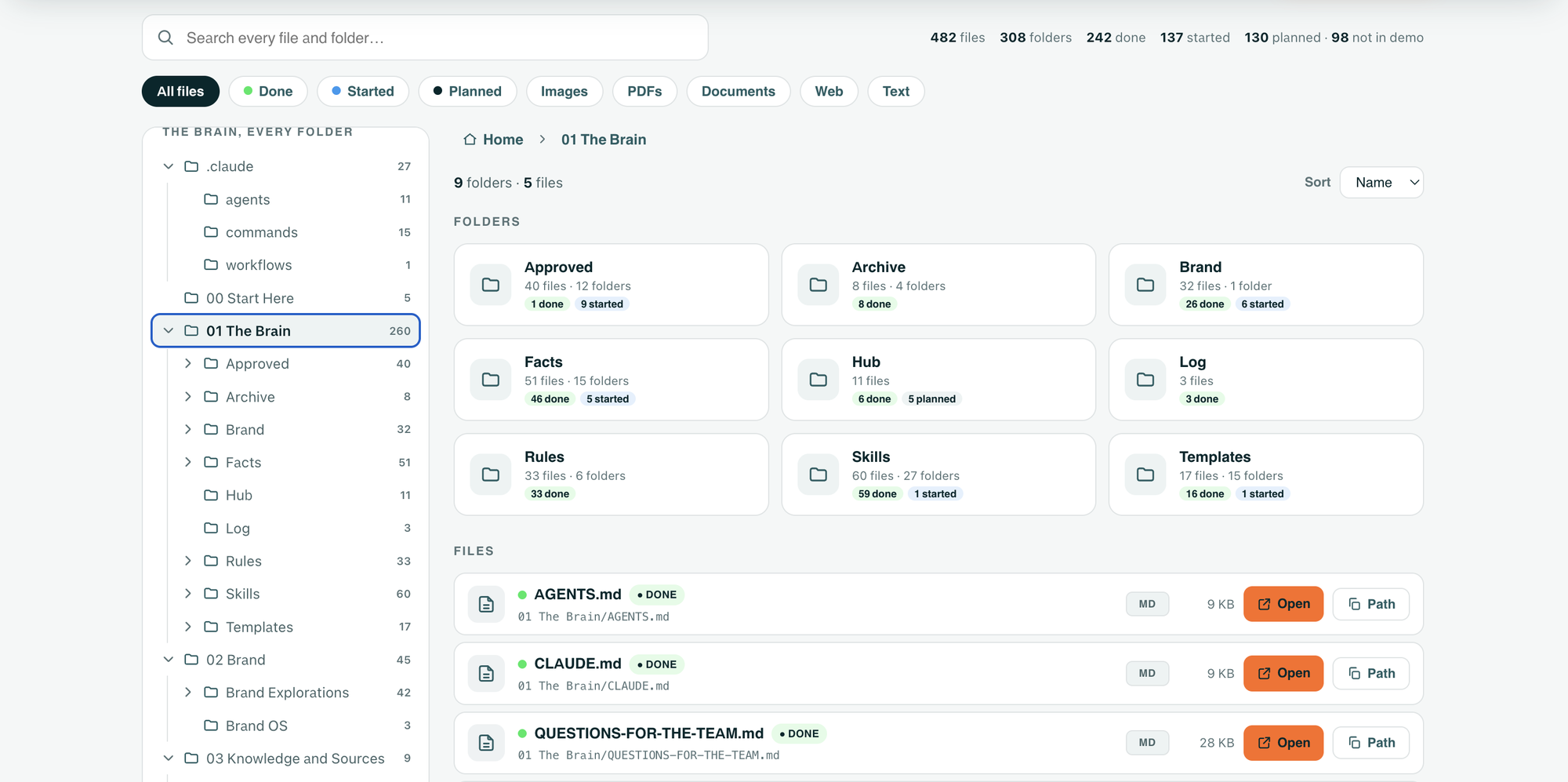
This is the architecture, and it is the shape every installation shares, whatever the company. The fastest way to inspect a real one is the live demo: the flagship system rebuilt with every client detail replaced, folder tree and constitution included.
The Loop, Running
Watch it run.
A week of work moves through the system: fictional company, fictional numbers, and one deliberate mistake. The drafted report ships with a wrong total and an ungrounded claim, because the interesting part is what happens next. Step through it.
A recorded run of the loop, replayable. The sales data is invented. The gate math is not: your browser recomputes every figure from the table and fails the draft itself. Nothing you do here is transmitted.
- 01 DATA
- 02 DRAFT
- 03 THE GATES
- 04 REVISED
- 05 APPROVED
- 06 FILED
Stage 01. The data
Apex Instruments, unit sales by week:
| Product | W31 | W32 | W33 | W34 |
|---|---|---|---|---|
| Meridian starter kit | 310 | 342 | 355 | 361 |
| Atlas field case | 190 | 178 | 205 | 214 |
| Vega bench lamp | 96 | 104 | 99 | 118 |
Live business data connected to the OS. In production this is a database or an export the system reads, never a number a model remembers.
Versus an AI Login
Capability is the easy part.
This is what the OS layer adds that buying an LLM does not. ChatGPT Enterprise, Copilot, and Gemini are capability. Without the layer around them, ten employees using the same LLM are still ten completely different ways of working.
I do not give companies access to AI. I build the infrastructure that makes AI work like it belongs inside that company.
- Company knowledge
- Institutional memory
- Source hierarchy
- Company rules
- Brand standards
- Agents
- Skills
- Workflows
- Permissions
- Approvals
- Integrations
- Live data
- Employee workspaces
- QA
- Governance
- Training
- Adoption
Where I Stop
I build with LLMs. Not the underlying LLMs themselves.
I personally take a system from business problem through architecture, knowledge, agents and skills, governance, integrations, interface, testing, rollout, and adoption. That is the whole span of an installation, and it is all one discipline.
What I am not: a machine learning researcher, a foundation model trainer, or an infrastructure engineer. Where enterprise security, authentication, or specialized backend engineering enters, I architect alongside those specialists rather than pretending to be one. They determine how their layer is built. They do not have to determine the business solution, because that is the part I bring.