
The Brains
Four systems, four businesses, one architecture.
Each one is a company brain, the knowledge core of the Company OS: the layer that holds what the company actually knows, so the Brand OS, the Operating Loop and the Gates all have something true to stand on. In practice that means a constitution the agent reads first, a routing table that loads only what a task needs, a trust hierarchy for when sources disagree, and guardrails that refuse rather than guess. All four are browsable below.
Explore
Walk any of them.
Spectrum Killian
A 16-lab dental manufacturer. Built solo when I was the only marketer supporting 50+ requesters. 5,289 files, six zones, thirteen generators. The one with 100+ daily users behind it.
Explore → Gen 2 · July 2026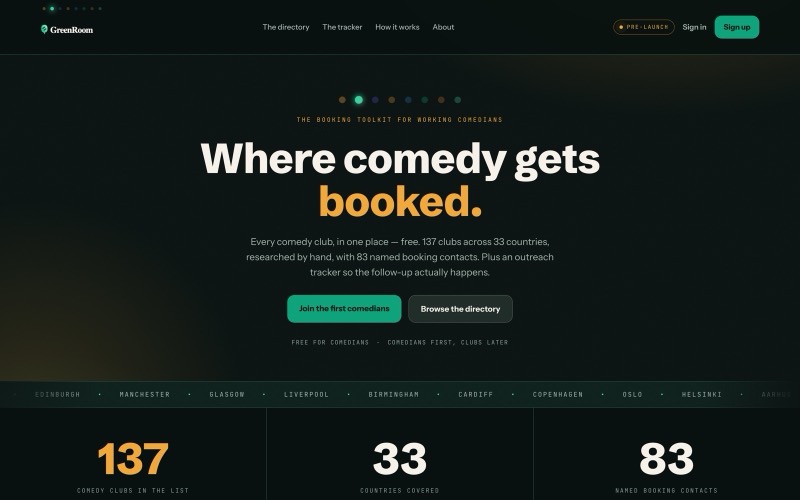
GreenRoom
A booking platform for comedians, where I am a co-founder. The constitution nearly halved, and the hub build script started asserting its own correctness on every deploy.
Explore → Gen 3 · July 2026Homeowner Insights
A Florida reserve-study firm replacing a marketing agency. The build where prose rules became executable gates: QA runs inside the deploy, so a violation fails the build instead of publishing.
Explore → Gen 4 · August 2026A confidential integration
A governed AI operating system for a company whose business units had grown apart. Multi-agent verification in fresh contexts, a refusal-based acceptance test, and a constitution generated from what is actually installed.
Explore the rebuild →The Evolution
Smaller, and more capable.
The constitution more than halved while the system got more capable, and that is the strongest evidence on the site. Not that one system worked, but what changed across four. The four constitutions were rewritten within about two weeks of each other, which is why the arc is legible: same author, same architecture, four different businesses, one decision at a time. Shorter is not the achievement. A rulebook a director can read in one sitting is one a company can actually enforce.
The constitution shrank
The enforcement moved into scripts, then into the system
Compression, with rising capability
The first constitution carried change history inline in its routing table. By the fourth, history had moved to a decisions log and the routing table was generated from the installed skill list. The constitution stopped describing the system and became an output of it. Nobody has to remember to update it, so the rules an agent reads never drift behind what the company installed.
Knowing when not to compress
Generation three goes back up, from 80 lines to 110. The client was new to AI, so the constitution states plainly: explain in plain language, never assume jargon, and when a request is ambiguous ask two or three multiple-choice questions rather than guessing.
That is the signal I would want read most carefully. The compression was a judgment each time, not a habit.
Prose rules became executable gates
In generation one, "no em dashes" was item seven on an output checklist, which is asking a model to check itself. By generation three it is a regular expression inside the deploy script with a non-zero exit code. A brand violation fails the build rather than reaching a client.
A real acceptance test
Four questions that prove an install works, where two of the four correct answers are refusals. Testing that a system declines to answer is materially harder, and more useful, than testing that it produces output. Those refusals are why a manager can act on the other two answers without checking the file first.
Multi-agent orchestration as doctrine
Verification runs in fresh contexts, because a worker grading its own output is nodding along to itself. Different lenses rather than repeated passes, because three different lenses catch what ten identical ones miss. And every graph terminates in something deterministic, because a scanner exiting clean is a signal and an agent saying it is done is not.
What never changed
Across all four: read the map rather than crawling the folders, a routing table, a three-tier trust order, UNKNOWN over a guess, placeholder over fabrication, never edit an approved file in place, and archive rather than delete.
Four out of four means those were the load-bearing primitives, and I found them in the first build.
The Starter Kit
The method, productized.
The Brain Starter Kit is what those four builds compressed into: a five-layer architecture (Brain, Hub, Rails, Skills, Handoff), an instantiation playbook, a deploy recipe carrying every gotcha the builds surfaced, and a port script that drops a full 22-tool build into any new brain pre-seeded with the client’s brand.
It has one standing rule: after every client build, spend thirty minutes backporting improvements, so the kit is never older than the newest system. And it exists for one reason: proof that the first one was not luck. The same architecture runs my own household as a family brain. A company starting one now begins where the last build ended, with the corrections already made.
On the Fourth One
Real machinery. Invented client.
That engagement is confidential until its public announcement, and the repository is employer property. Rather than redact it, which still leaves you holding a copy of a confidential repository, I rebuilt the architecture from scratch under an invented client. Every fact on that page is fabricated. The machinery is real.