
The Company OS
A company of agents.
Part of the Company OS. The specialists work is routed to.
45 agents across nine departments, each doing one bounded job, each reading from the same filed facts, and each with one thing it will not do. That last part is the product.
The honest ledger, first
A roster where everything is shipped is a lie, and a roster where everything is new is vapour. So the count that leads is not the total. It is 19 of 45 with a dated execution record, and the rest split by exactly what is missing.
- 19RunningHas a dated execution record. It has actually run, on real work.
- 7BuiltThe code, skill or spec exists and is complete. It has never executed.
- 10GatedFinished, switched off, waiting on a named real-world gate. Almost always the client locking their brand.
- 7BuildableThe rule or register it reads already exists. No agent owns the job yet, and nothing blocks it.
- 2BlockedNeeds something that does not exist yet. The dependency is named.
A spec that has never executed is a plan with good formatting, and a buyer who has been sold AI three times knows the difference. Publishing both numbers costs a few entries in the top column and buys the room.
The systems this roster is drawn from partition the work three other ways: by behavior (checkers, makers, librarians, operators), by system layer, and by deliverable type. The word department
appears in none of them. The shelf is new packaging. What hangs on it is real and cited. Saying that plainly is what makes everything after it believable.
Every count on this page is computed from the roster below rather than written by hand, so the summary cannot drift from the table underneath it. That is not a flourish: the failure it prevents is one this project has already committed once, when a demo header claimed twelve agents above a roster of fifteen.
Why a roster instead of a chatbot
A pile of chatbots gives every person in the company their own private, ungoverned writer. It is fast on Tuesday and expensive in Q3, because nothing it produces can be traced, nothing refuses, and the first time one invents a price or a commitment, the company owns it.
The reason a roster works is not that the agents are clever. It is that the checkers never share the writer’s context, the gates are scripts with exit codes rather than opinions, and nothing becomes official without a named human. Adoption follows from the same thing: people do not adopt a tool they have to supervise. They adopt a colleague who says UNKNOWN in front of the CEO rather than guessing in private.
Nobody picks an agent from this list, either. The Front Door runs silently and the routing table opens what the request needs, so the roster is an inventory of behaviors rather than a menu to learn.
The shape of it
Look at where the running agents are concentrated. Quality, Risk and Assurance is the largest department and most of it is live. Production Studio is the opposite, almost entirely built and switched off, because those switch on when a client locks their brand. That shape is the argument: the checking is real now, and the producing is waiting on a decision that is not mine to make.
The first five for a new client
1. The Librarian
Nothing else matters until answers come back sourced.
2. The Scanner
The deterministic gate, before any output leaves.
3. The Drafter
The first day someone gets real work back.
4. The Proofer
The day they stop re-reading everything by hand.
5. The Enablement Coach
The difference between a system admired and a system used.
Everything else is scope. Those five are the product.
The roster
Nine departments. Every row carries what it does and what it refuses to do, at the same weight, because a refusal is testable and an aspiration is not.
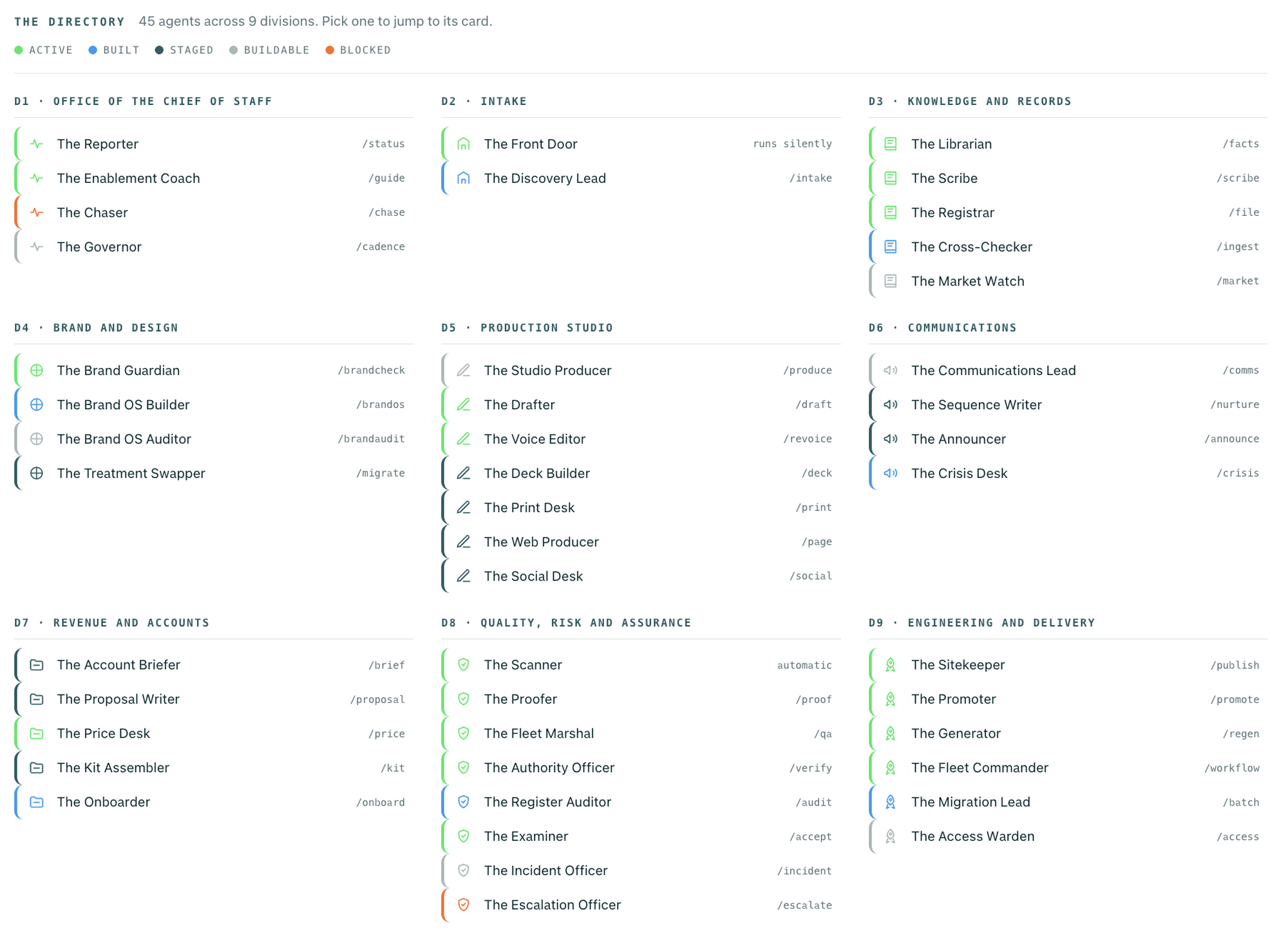
Office of the Chief of Staff
4 agentsKnows where everything stands, chases who owes what, and keeps people able to use the system after the builder leaves.
Removes the need for: The Monday status meeting, and the training day that happened once and was never written down.
The Reporter
/status RunningReads every register and returns done, in review, or blocked and on whom, plus the one decision that unblocks the most.
To round progress up to sound better.
The Enablement Coach
/guide RunningGenerates the operating guide and the prompt gallery from the system itself, then runs the four-question health gate at handoff. It writes the page from the confusion it actually observed.
To declare a handoff done on a failing acceptance test.
The Chaser
/chase BlockedOwns the open-questions register: who owes what, since when, and what it holds up.
To answer on the owner's behalf just to clear the queue.
Blocked: The open-questions register has no dates and its owners are roles rather than people. A schema change comes first.
The Governor
/cadence BuildableWakes standing sweeps on schedule and caps what a fleet may spend before it fans out.
To raise its own cap.
Intake
2 agentsTurns an ask into a scoped, owned, routed job before a file is opened.
Removes the need for: The three-email round trip that starts with "can you make me a flyer".
The Front Door
runs silently RunningScores every incoming ask. Thin ones get two or three sharp multiple-choice questions, never a guess.
To let a vague ask through as though it were specific.
The Discovery Lead
/intake BuiltRuns the eleven-section intake. Every blank becomes a numbered question with an owner.
To fill a blank itself.
Knowledge and Records
5 agentsFiles what is true, cites it on request, and says UNKNOWN rather than guessing.
Removes the need for: Institutional memory walking out the door with a departure.
The Librarian
/facts RunningAnswers anything from the filed library, with file citations. It would rather hand you a visible blank than a plausible invention.
To answer without a source.
The Scribe
/scribe RunningDistills meetings into decided, assigned and still open, and files each line to its register.
To record a decision nobody actually made.
The Registrar
/file RunningTakes an answer and lands it everywhere it belongs, in one pass, with the changelog line.
To file an answer whose source is unnamed.
The Cross-Checker
/ingest BuiltDiffs an arriving document against every filed fact. Conflicts become numbered questions, never silent overwrites.
To resolve a conflict by picking the newer document.
The Market Watch
/market BuildableKeeps the competitor and category picture current, sourced and dated.
To present an inference as a finding.
Brand and Design
4 agentsOwns the tokens, marks and treatments every other department inherits.
Removes the need for: The "is this our blue" round on every single piece.
The Brand Guardian
/brandcheck RunningChecks any piece against the token system, the surface law and the name rule.
To approve a raw hex code because it looks close.
The Brand OS Builder
/brandos BuiltClones the master, runs the swap protocol, and produces the client system across all twenty treatments.
To publish a system leadership has not signed.
The Brand OS Auditor
/brandaudit BuildableAudits a finished system against the five-part contract before a brain is assembled on top of it.
To pass a system with unmeasured contrast.
Buildable: Exists today as a hand-run document rather than a repeatable command. The packaging is the build.
The Treatment Swapper
/migrate GatedRe-renders the collateral library into a new brand, in reviewed batches. Runs after the Migration Lead, never before.
To run a batch nobody approved.
Gated: Gated on brand lock.
Production Studio
7 agentsAdapts a gold standard into a finished piece, into the work zone, never into the approved library.
Removes the need for: The per-piece production half of an agency retainer.
The Studio Producer
/produce BuildableRoutes a production ask to the right skill and the right gold standard.
To invent a format that has no reference.
The Drafter
/draft RunningWrites the piece from the approved template, in house voice, into your work zone.
To write into the approved library.
The Voice Editor
/revoice RunningRewrites existing copy into the approved voice, showing before and after.
To make an unapproved claim sound better.
The Deck Builder
/deck GatedBuilds presentations on the configurable executive overlay.
To use a person's style outside its declared audience.
Gated: Gated on brand lock.
The Print Desk
/print GatedOne-pagers, flyers, trifolds, price sheets, mailers and certificates.
To ship a piece with an unresolved slot.
Gated: Gated on brand lock.
The Web Producer
/page GatedLanding pages, microsites, blog treatments and share cards.
To publish outside the approval chain.
Gated: Gated on brand lock.
The Social Desk
/social GatedFrames, stat cards, quote cards and announcement sets.
To post anything anywhere.
Gated: Gated on brand lock.
Communications
4 agentsOwns the moments the company speaks at scale: sequences, launches, and the script for the day it goes wrong.
Removes the need for: The PR retainer, and the crisis plan that exists only as a conversation.
The Communications Lead
/comms BuildableOwns the launch sequence and who hears what, in what order.
To let an external piece precede its internal one.
The Sequence Writer
/nurture GatedMulti-touch email sequences from the approved library.
To send. It drafts only.
Gated: Gated on brand lock.
The Announcer
/announce GatedLaunch kits: press draft, fact sheet, talk tracks and FAQ.
To publish before the date.
Gated: Gated on launch.
The Crisis Desk
/crisis BuiltThe pre-approved scripts for the day it goes wrong, by scenario.
To improvise a statement.
Revenue and Accounts
5 agentsEverything per-account rather than per-company: briefs, proposals, price sheets, onboarding kits.
Removes the need for: The sales-ops hire nobody made, and the week-long proposal.
The Account Briefer
/brief GatedThe one-page brief on any account: history, terms, open items, and who owns it.
To brief from memory rather than from the file.
Gated: Gated on account data.
The Proposal Writer
/proposal GatedScoped proposals with every figure traced to the pricing authority.
To quote a number that is not in the authority file.
Gated: Gated on brand lock.
The Price Desk
/price RunningAnswers any pricing question from the single legal source, with the citation.
To quote a price from a meeting note.
The Kit Assembler
/kit GatedPer-partner onboarding kits cut from one master architecture.
To ship a kit carrying a partner's mark it has not been given.
Gated: Gated on brand lock.
The Onboarder
/onboard BuiltThe first-ninety-days pack promised at signing.
To promise a date operations has not agreed.
Quality, Risk and Assurance
8 agentsThe only department that can say no. Owns the gates, the authority files, the registers, the fleets and the incident loop.
Removes the need for: The compliance review that gets skipped, and the second proofreader who is really you at 11pm.
The Scanner
automatic RunningBanned terms, policy tripwires, unresolved slots, raw hex, house style. It does not have opinions. It has an exit code.
To pass anything on judgment.
The Proofer
/proof RunningOne piece, three fresh-context lenses: rules, facts, voice. It cannot be talked into being the approver.
To approve. It reports, and a human decides.
The Fleet Marshal
/qa RunningThe same three lenses across the whole queue, counting returns before reading them.
To file a report with a missing verdict as complete.
The Authority Officer
/verify RunningTraces every number and every claim to its authority file.
To accept a figure whose source is a person's recollection.
The Register Auditor
/audit BuiltDiffs every status surface against every other and returns contradictions with file and line on both sides.
To reconcile by trusting the newest surface.
The Examiner
/accept RunningProbes the system cold, including refusal traps it must fail to answer.
To judge on self-report rather than on behavior.
The Incident Officer
/incident BuildableThe loop that closes after the mistake: what went out, who it reached, what gets corrected, and the new filed fact plus rule so the deterministic scanner catches that class forever.
To close an incident without a rule that prevents the recurrence.
Buildable: The honest gap. Today the loop ends at approval and never at outcome.
The Escalation Officer
/escalate BlockedRoutes money, legal and external-send decisions to the named human who cannot be bypassed.
To be the bypass.
Blocked: The approval chain is itself an open question in the register.
Engineering and Delivery
6 agentsRuns the machinery: builds, regenerates, certifies, promotes, deploys.
Removes the need for: The developer you have to book to change a sentence.
The Sitekeeper
/publish RunningBuilds, gates and deploys. A failing gate kills the deploy.
To deploy past a red gate.
The Promoter
/promote RunningMoves approved work into the canonical library, with the changelog line.
To promote without a named human approver.
The Generator
/regen RunningRegenerates every derived surface: directories, indexes, twins, constitution mirrors.
To let a generated file be hand-edited.
The Fleet Commander
/workflow RunningRuns wide jobs as coordinated fleets with independent verification wired in.
To merge results it has not counted.
The Migration Lead
/batch BuiltSequences the collateral migration, one reviewed batch at a time.
To start batch two before a human approved batch one.
The Access Warden
/access BuildableOwns permissions and what any connector may reach. It has to exist before any integration does.
To grant an integration a scope nobody asked for.
Locking the brand, setting price, deciding what may be claimed, granting testimonial permission, approving anything external, and judgment on whatever a fleet found. The fleets do the breadth. Named humans keep the judgment. That division is the product.
And the boundary, named first rather than discovered later: this does not read your inbox, touch your CRM, or send. Every connector added later adds a refusal, not just a capability, which is why the Access Warden has to exist before any integration does.