
Demo
Move a price. Watch demand argue back.
The real engine recommended menu prices for a multi-market restaurant group, and a human approved every change before it touched a menu. This page is a recreation: the same shape of model and the same approval step, run on a menu that does not exist.
The engine, running
Price one item. The model does the arguing.
Pick an item and move its price. The model projects weekly volume from that item's elasticity, draws the revenue curve, and marks the price it would argue for. The one thing it never does is approve itself.
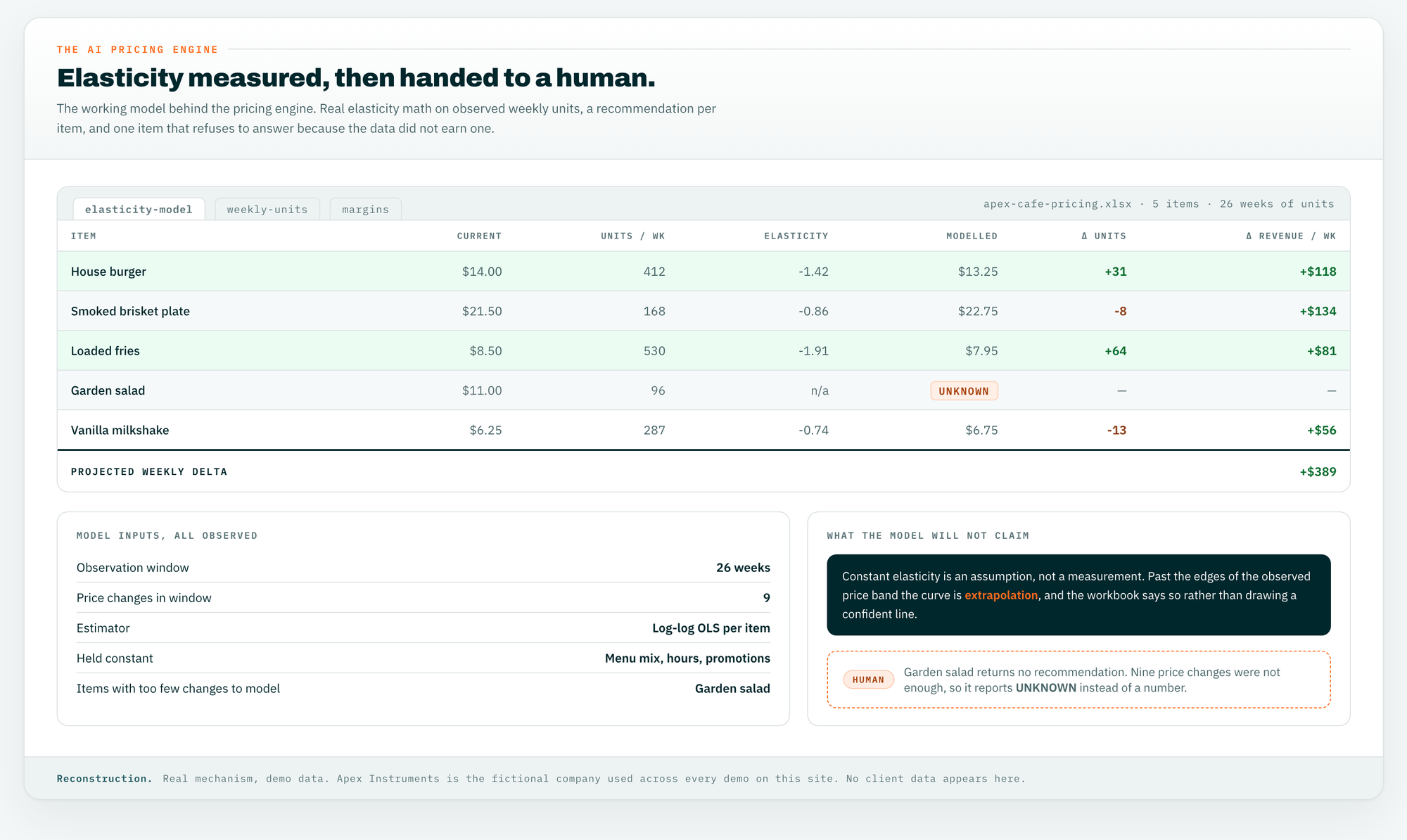
Fictional menu, fictional volumes, real math. The elasticity model runs live in your browser. Nothing is transmitted.
Apex Cafe, the menu as it stands:
| Item | Base price | Weekly units |
|---|---|---|
| House burger | $12.50 | 420 |
| Loaded fries | $6.25 | 610 |
| Smoked brisket plate | $18.75 | 190 |
| Garden salad | $9.50 | 240 |
| Vanilla milkshake | $5.75 | 330 |
The base state the model starts from. With JavaScript on, the controls below run it against any price you choose. With JavaScript off, this table is the demo.
Modeled weekly revenue across the tested price band. The vertical axis covers the band's own range, not zero. The shape is the point.
RECOMMENDATION (draft): move the price and the model recomputes its case.
The real one
How the real engine worked.
It read four kinds of evidence: historical sales before and after every price change, demand elasticity, competitor pricing, and consumer psychology research. From those it recommended menu prices.
Humans curated everything that went in, and validated every recommendation through iterative passes before anything changed. The outputs drove real menu decisions across the group.
No outcome metric appears here because none is defensible. Sales move for a dozen reasons at once, the engine was one of them, and this site does not publish numbers it cannot defend.
Honest scope
What this recreation keeps, and what it flattens.
It keeps the discipline: a model that argues from elasticity, and a human gate it cannot cross on its own. It flattens the evidence: one exponent per item stands in for the four kinds the real engine read.
The flattening shows, and it is worth seeing. Under constant elasticity, revenue only ever slopes one way, so inside a tested band the model's best answer is always an edge of the band: cut the price-sensitive items, raise the destination dishes. The real engine read more than one number per item, which is exactly why its recommendations could land somewhere less obvious.
The approval step. A recommendation became a price only when a person said so, and the decision was filed with the reasoning that produced it. That is the piece this demo refuses to automate away, on this page as in production.